

Key Takeaways for Procurement & ESG Leaders:
•The Scope 3 Blind Spot: Up to 95% of a company’s carbon footprint lies in its supply chain (Scope 3), yet most data remains unverified and invisible to procurement teams.
•The Cost of Short Lifespans: 80% of a smartphone’s carbon footprint is generated during manufacturing. Extending its use from 2.5 to 5 years cuts annual emissions by 35%.
•Fast Fashion vs. Longevity: Fast fashion garments are worn an average of 10 times, while classic garments last decades, drastically altering the true cost-per-wear and environmental impact.
•Marketing’s New Role: Educating consumers on product lifespan is significantly cheaper and more effective than investing millions in complex Net Zero carbon offset programs.
•The Solution: Moving from declarative ESG to verified supplier truth is essential to mitigate regulatory risks (CSRD, CSDDD) and achieve genuine sustainability.

We live in an illusion of sustainability. Across boardrooms and annual reports, Net Zero pledges multiply. ESG commitments are made, frameworks are adopted, and sustainability officers are hired. Yet a colossal blind spot continues to undermine these efforts — one that rarely appears in the glossy sustainability reports: the actual lifespan of the products we make and consume.
Behind the promises of carbon neutrality lies an economy of the ephemeral, where obsolescence — whether engineered, perceived, or culturally induced — dictates the pace of production. The faster products cycle through our hands, the more raw materials are extracted, the more factories run, the more carbon is emitted — and the more of it disappears into the invisible depths of Scope 3. So how long does a product really live? And what is the true hidden cost of its brevity?
What is the history of planned obsolescence?
The story of shrinking product lifespans did not begin with the smartphone era. It began, quite literally, with a lightbulb.
In 1895, a standard lightbulb lasted approximately 1,500 hours. By 1924, technological progress had extended that lifespan to 2,500 hours. The world’s leading lightbulb manufacturers — Philips, Osram, General Electric — promptly formed the Phoebus Cartel in Geneva and agreed to deliberately reduce the lifespan of their bulbs back down to 1,000 hours. The stated reason was “improved efficiency.” The real reason was that bulbs lasting too long were bad for business.
This episode, now a century old, established a template that would be replicated across virtually every consumer industry: design products to expire, and growth will follow. Bernard London, a real estate broker writing during the Great Depression, formalised the concept in 1932, coining the term “planned obsolescence” and proposing that all products be assigned a mandatory expiry date to stimulate purchasing. The idea was radical then. Today, it is the default.
“Instilling in the buyer the desire to own something a little newer, a little better, a little sooner than necessary.” — Brooks Stevens, industrial designer, 1954
The acceleration has not slowed. If anything, it has intensified. The fashion industry now produces an estimated 100 to 150 billion garments per year — twice the volume it produced in 2000 — while the average number of times a garment is worn before being discarded has fallen by more than 35% in just 15 years. Clothing is now worn an average of 7 to 10 times before it is thrown away.
How does product lifespan affect carbon footprint? A Smartphone Case Study
No product better illustrates the paradox of the throwaway economy than the smartphone. It is the most sophisticated object most people will ever own, assembled from over 60 different elements of the periodic table — including cobalt mined in the Democratic Republic of Congo, rare earth metals extracted in Inner Mongolia, and gold refined across multiple continents. And yet, in Germany, the average smartphone is replaced every 2.5 years.
To understand why this matters, one must look at the full lifecycle of a smartphone — not just the glowing screen in your pocket, but the entire chain of events that brought it there.
[Figure 1 — Smartphone Lifecycle: Carbon Footprint Breakdown]
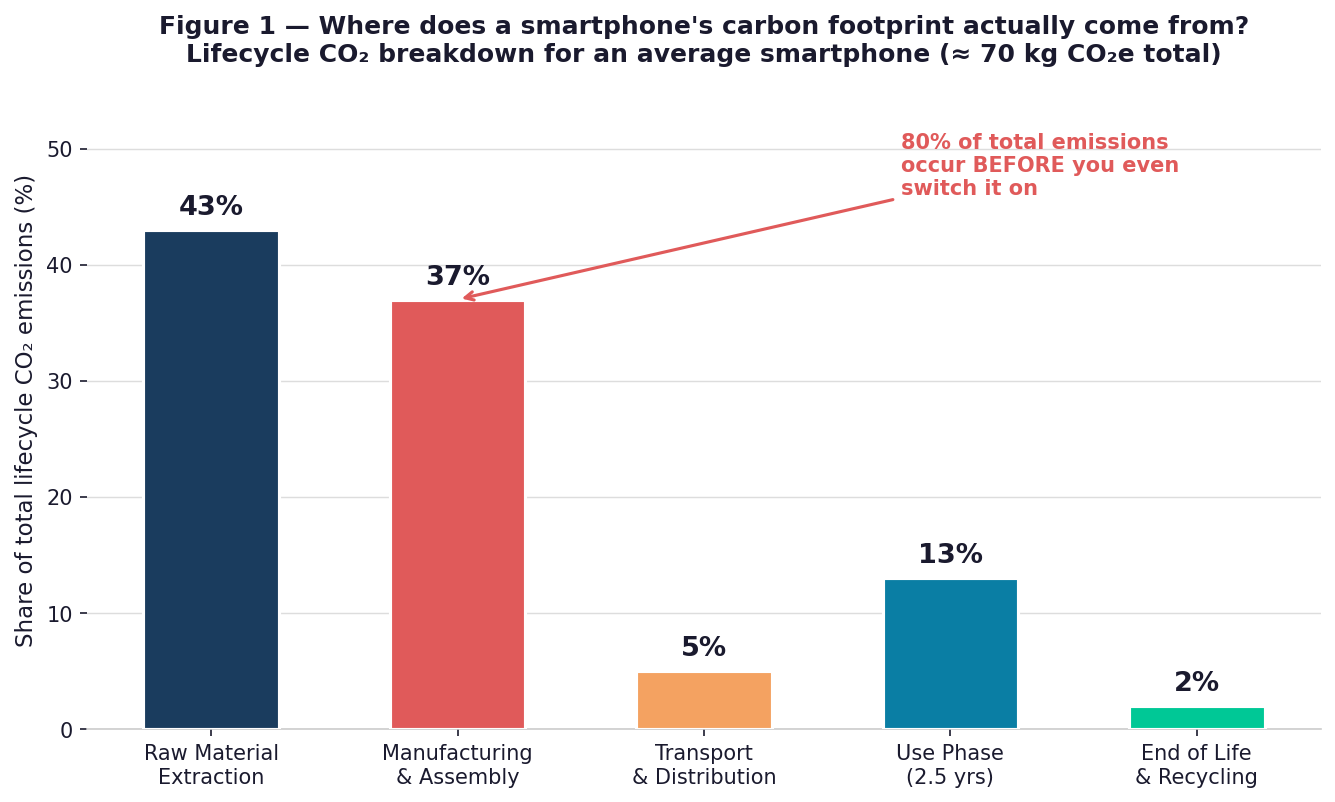
The data is striking. Approximately 80% of a smartphone’s total carbon footprint is generated before the device is ever switched on — during the extraction of raw materials (43%) and the manufacturing and assembly process (37%). The use phase, which is the only part of the lifecycle the consumer actually experiences, accounts for just 13% of total emissions. End-of-life recycling, often cited as a sustainability solution, contributes a mere 2%.
This means that the decision to replace a phone after 2.5 years rather than 5 years is not a minor consumer choice. It is a decision to trigger an entirely new round of mining, smelting, chemical processing, and global shipping — all of which carry enormous environmental costs that are almost entirely invisible to the end consumer and, critically, to the procurement teams of the brands that commission these supply chains.
[Figure 2 — The Impact of Keeping Your Phone Longer]
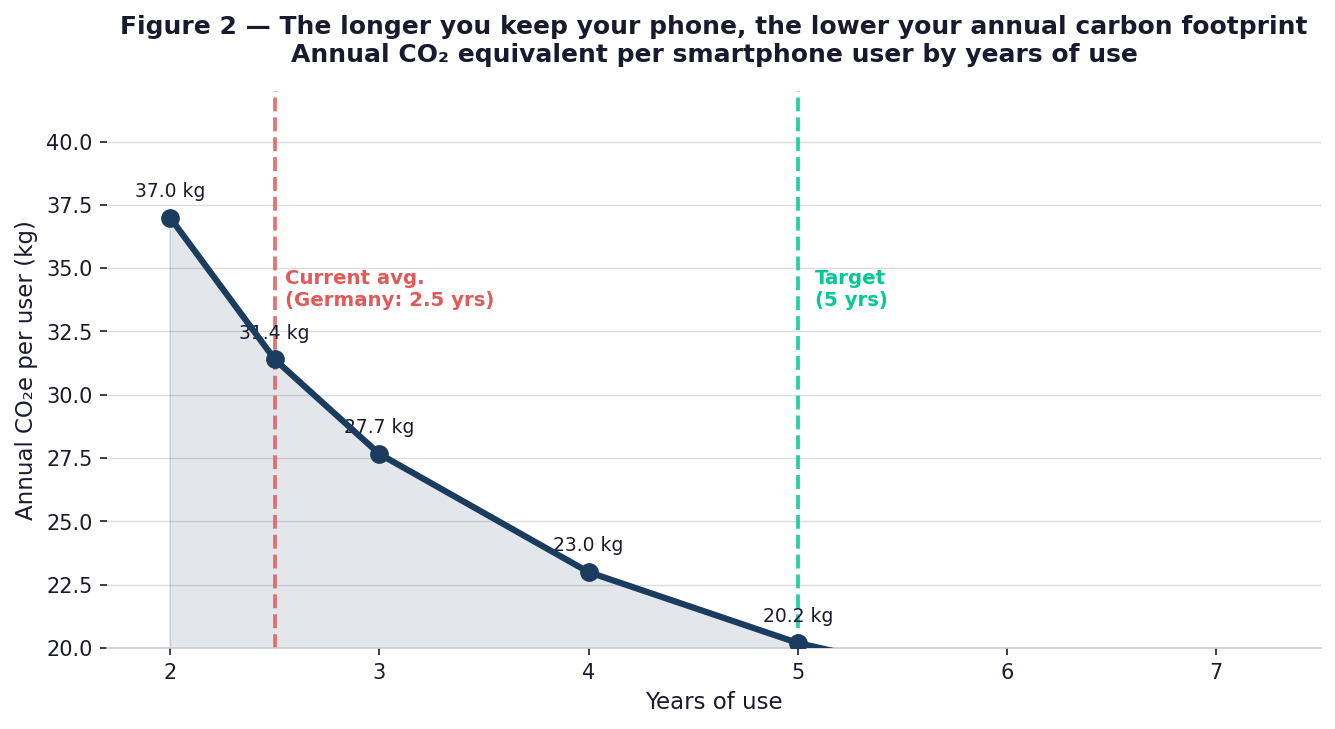
The mathematics are unambiguous. A smartphone used for 2.5 years generates approximately 31 kg of CO₂ equivalent per year of use. The same device, kept for 5 years, generates just 20 kg per year — a reduction of nearly 35% in annual carbon intensity, with no change in the product itself. Extending the average smartphone lifespan to between five and seven years could, according to the Wuppertal Institute, halve the greenhouse gas emissions associated with these devices in Germany alone.
Yet the business model of the entire electronics industry — from chipmakers to network operators — is built around the 2-to-3-year replacement cycle. Software updates are discontinued. Batteries are made non-replaceable. New features are introduced at a pace calibrated to make last year’s model feel obsolete. The product does not die because it stops working. It dies because we are told it should.
Fast Fashion vs. Luxury: Do We Still Wear a 1950s Dior Jacket?
The question sounds almost absurd. But it is, in fact, the most revealing question one can ask about the fashion industry.
The answer is: yes, some people do — and those jackets are worth more today than when they were made. A 1947 Christian Dior “New Look” bar jacket, constructed from wool barathea with hand-stitched internal boning and a horsehair-padded hem, was designed to last decades. It was made to be worn, altered, repaired, and passed down. Vintage Dior, Chanel, and Balenciaga pieces from the 1950s and 1960s regularly appear at auction and on the backs of fashion editors — not as curiosities, but as functional, wearable garments that have outlasted entire generations of their owners.
This is not nostalgia. It is a radically different economic and environmental model.
[Figure 3 — Fast Fashion vs. Classic / Luxury Fashion: A Tale of Two Economies]
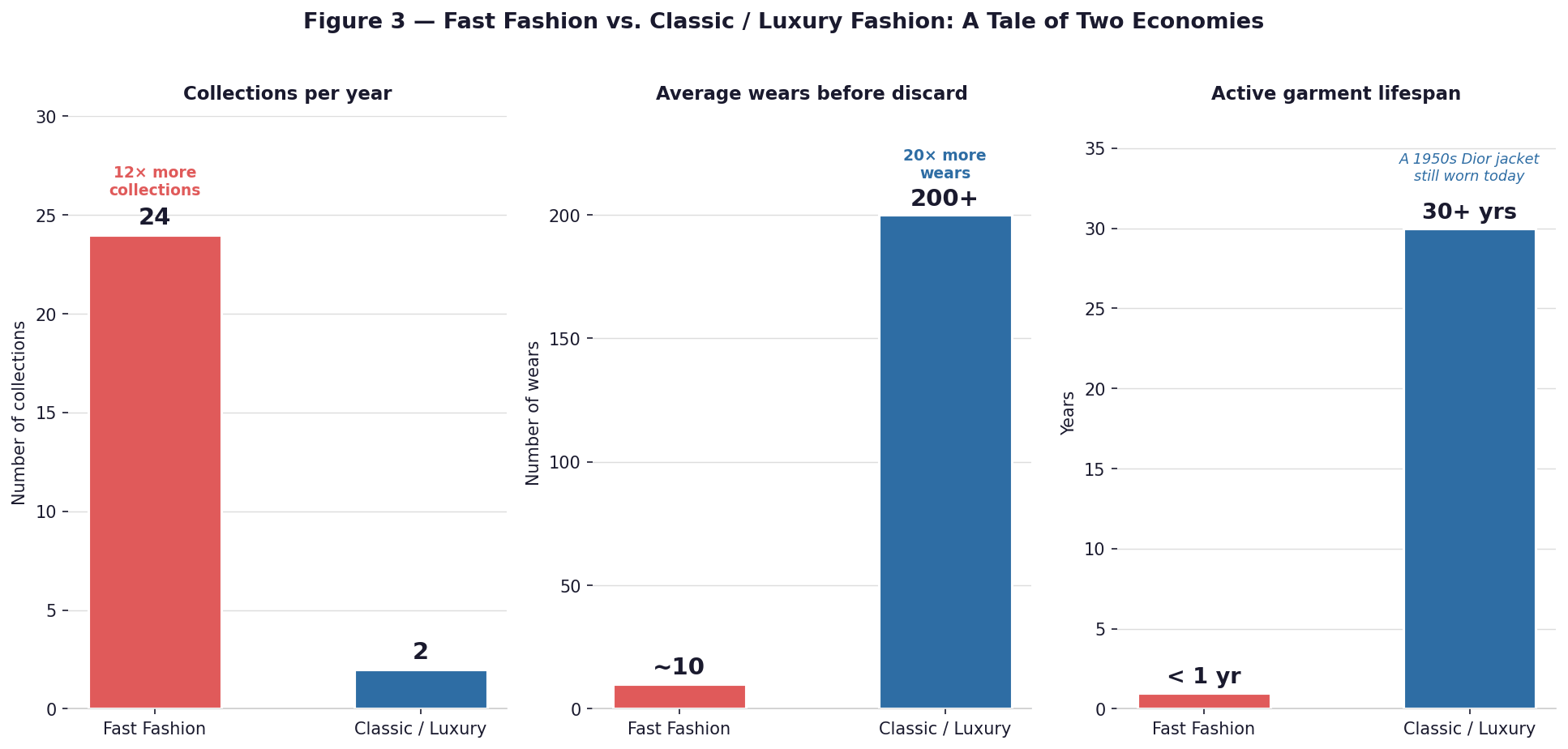
The contrast between fast fashion and classic fashion is not merely aesthetic — it is systemic. Zara, the world’s largest fast fashion retailer, releases approximately 24 collections per year. H&M produces between 12 and 16. Shein, the ultra-fast fashion platform, introduced over 315,000 new items in 2022 alone. Haute couture houses, by contrast, present two collections per year — and those collections are designed to endure.
The consequences are measurable. A fast fashion garment is worn an average of 7 to 10 times before being discarded. A well-made classic garment — a tailored coat, a quality leather shoe, a structured blazer — can accumulate 200 or more wears over a decade or more of active use. The active lifespan of a fast fashion piece is often less than one year. A classic garment can remain in active use for 30 years or more.
The environmental arithmetic is equally stark. The fashion industry is responsible for approximately 10% of global CO₂ emissions and generates 92 million tonnes of textile waste per year. Half of those emissions, according to research published in Journal of Cleaner Production, are attributable specifically to fast fashion. And yet, the supply chains behind these garments — the cotton farms in Uzbekistan, the dyeing facilities in Bangladesh, the polyester mills in China — remain almost entirely opaque to the brands that source from them.
The deeper irony is this: a fast fashion brand producing 24 collections per year generates far more Scope 3 emissions per unit of value delivered than a luxury house producing two. But because Scope 3 emissions are measured at the brand level rather than the product level, and because supply chain data is largely self-reported and unverified, this disparity is almost never visible in corporate sustainability reports.
What are Scope 3 emissions in the supply chain?
Scope 3 emissions represent the indirect greenhouse gas emissions that occur in a company’s value chain. For most companies, Scope 3 is not a secondary concern. It is the primary one.
[Figure 4 — The Scope 3 Iceberg: What Companies Report vs. Where Emissions Actually Live]
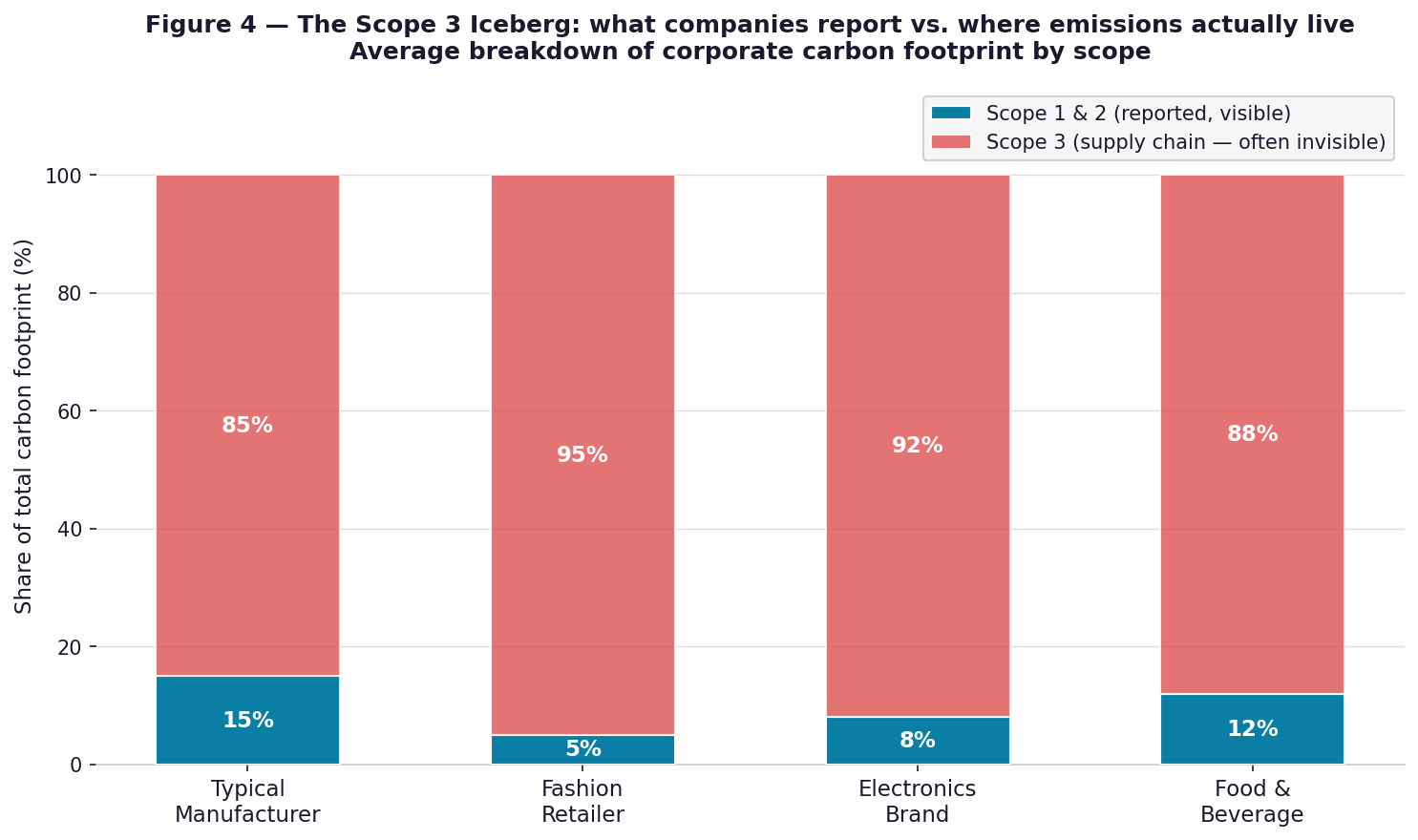
For a fashion retailer, Scope 3 emissions typically represent 95% of total corporate carbon footprint. For an electronics brand, the figure is approximately 92%. For a food and beverage company, 88%. In other words, the emissions that companies most prominently report — their own operations, their owned vehicles, their purchased energy — represent a single-digit percentage of their actual climate impact.
The rest lives in the supply chain. It lives in the mines, the factories, the farms, the logistics networks, and the waste streams of thousands of suppliers, sub-suppliers, and sub-sub-suppliers that most procurement teams have never directly engaged with. It lives, in the language of BE-CAUSE, at tier-n — the layers of the supply chain that are invisible to the brands that depend on them.
This is not merely an accounting problem. It is a strategic risk of the first order. Companies that cannot see their Scope 3 emissions cannot manage them. Companies that cannot verify their suppliers’ ESG claims cannot trust them. And companies that cannot trust their supply chain data cannot credibly commit to Net Zero — regardless of how many pledges they sign or how many reports they publish.
The New Role of Marketing: Selling Longevity Over Volume
If the root cause of the throwaway economy is the relentless push for volume, the solution must involve a fundamental shift in how products are marketed. Historically, marketing teams have been tasked with driving the replacement cycle — convincing consumers that last year’s model is obsolete and that newness equals value.
Today, the role of marketing must evolve to explain and valorize the lifespan of the product. Educating consumers on how to maintain, repair, and maximize the use of a product is not just an exercise in brand building; it is a highly efficient decarbonization strategy. Investing in marketing campaigns that promote product longevity costs significantly less than investing millions in complex, often dubious Net Zero carbon offset programs.
When a brand successfully convinces its customers to keep a product twice as long, it effectively halves the per-user manufacturing emissions associated with that product line. Marketing longevity — turning durability into a premium feature and repairability into a status symbol — is one of the most cost-effective levers a company has to reduce its true environmental impact.
Rewriting the Phoebus Cartel: Business Models for a Sustainable Future
The ultimate challenge, however, lies deeper than marketing. It requires dismantling the century-old logic of the Phoebus Cartel. How can a company make its business sustainable — both economically and environmentally — if it no longer relies on endlessly growing sales volumes? How does a business survive when sales stabilize or even decrease?
The answer lies in decoupling revenue from resource extraction. Business models must shift from selling discrete products to selling services, performance, and longevity. This transition takes several forms:
•Product-as-a-Service (PaaS): Companies retain ownership of the product and lease its use (e.g., Philips selling “light as a service” rather than lightbulbs). This aligns the manufacturer’s financial incentive with making the product last as long as possible.
•Monetizing the Aftermarket: Brands can capture value through certified repair services, official refurbishment programs, and second-hand marketplaces. Apple and Patagonia are already proving that the secondary market can be highly profitable.
•Premium Pricing for Durability: As consumers become more aware of the true cost of cheap goods, brands that offer verifiable longevity and transparent supply chains can command a premium, maintaining revenue even as unit volumes decrease.
To survive the transition away from the throwaway economy, companies must learn to profit from the lifecycle of the product, not just its point of sale.
From Declarative ESG to Verified Truth
The regulatory environment is beginning to reflect this reality. The EU’s Corporate Sustainability Reporting Directive (CSRD) and the Corporate Sustainability Due Diligence Directive (CSDDD) now require companies to report on and take responsibility for sustainability risks across their entire value chain — not just their own operations. The EU’s Right to Repair directive, effective by July 2026, will compel manufacturers to design products for longevity and provide access to spare parts and repair services. France has gone further, imposing fines of up to €300,000 and two-year prison sentences for companies found to be deliberately shortening product lifespans.
These regulations are not peripheral. They represent a fundamental shift in how the economy is expected to account for the true cost of production. And they create an urgent, practical problem for procurement teams: how do you verify what you cannot see?
The answer cannot be more self-reported questionnaires. Research consistently shows that 40% of ESG claims contain material inconsistencies when cross-validated against independent data sources. A supplier that declares compliance with environmental standards is not the same as a supplier that has been verified as compliant. The gap between declaration and truth is precisely where regulatory risk, reputational risk, and climate risk accumulate.
Closing that gap requires a new approach — one that combines multi-stakeholder validation, AI-powered inconsistency detection, and real-time supply chain intelligence to produce what declarative ESG never can: verified supplier truth.
The products we make tell a story about the economy we have chosen. The question is whether we are willing to read it honestly — all the way down to tier-n.
BE-CAUSE is an AI-powered ESG and supply chain intelligence platform that helps enterprise procurement teams move from declarative ESG to verified supplier truth. In 15 minutes, map the suppliers — and sub-suppliers — putting your targets, compliance, and reputation at risk.
Discover the platform:
https://www.be-cause.earth
References
[1] The Sustainable Agency. “The History of Planned Obsolescence.”
[2] UNEP. “Unsustainable fashion and textiles in focus for International Day of Zero Waste.”
[3] PIRG. “Fast Fashion by the Numbers.”
[4] UniformMarket. “Fast Fashion Statistics 2025.”
[6] American Chemical Society. “Listen Up! The Life Cycle of a Cell Phone.”
[7] Carbon Trust. “Circular economy and Net Zero: carbon footprinting and the mobile phone market.”
[8] NielsenIQ. “Shein, Zara, H&M: Close-up on the Ultra-Fast Fashion Market.”
[9] Digital World Online. “Luxury vs. Fast Fashion: Which Lasts Longer?”
[10] Earth.Org. “Fast Fashion and Its Environmental Impact in 2026.”
[12] Closing the Loop: The Power of a Circular Economy. OneStopESG.
[13] Nature. “Supply-chain data sharing for Scope 3 emissions.”
[14] BE-CAUSE. “From declarative ESG to verified supplier truth.”